March 20, 2009
Serendipitous Emissions Elasticity Experiment
The IMF projects global GDP to decrease this year for the first time in 60 years (below from BBC).
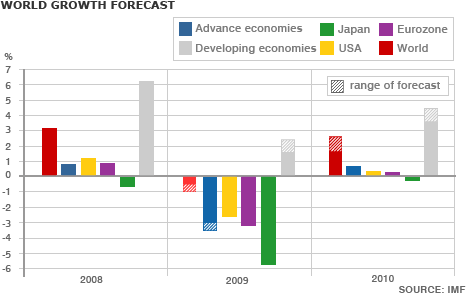
When we eventually learn what happens to global emissions in response to the economic downturn, we will learn something new about the relationship of GDP growth and emissions. In recent years that relationship has strengthened. What will 2009 tell us?
[Update]
Courtesy of Benny Peiser this translation of a Der Spiegel story on this exact subject today:
CO2 emissions increase despite crisis: researchers are puzzled
Contrary to all expectations, the financial and economic crisis does not appear to have slowed down the expected increase of greenhouse gases in the atmosphere. The concentration of carbon dioxide during the past year has risen above average, despite the fact that global economic growth was significantly weaker in 2008 than in 2007. These are the provisional results of the Global Carbon Project (GCP), an international research initiative which focuseson the global carbon cycle. Their data for 2008 will be officially published in the summer.
GCP Executive Director Pep Canadell told SPIEGEL ONLINE that the 2008 level of CO2 in the atmosphere had risen by 2.3 ppm, to around 385 ppm. The average increase during the previous nine years had been 2.0 ppm. “That really surprised us because the strong economic downturn began already in 2008,” said Canadell, a biologist in the department of marine and atmospheric research at the Australian government research organization, CSIRO in Canberra.
According to Canadell, the global gross national product (GDP) was 2.5 percent last year, despite the onset of the economic crisis. But it was not as strong as in 2007 when global GDP grew by 3.2 percent. Accordingly, the energy consumption of industrialized and emerging countries actually declined in 2008 – and thus also the associated global carbon dioxide emissions. [...]
GCP’s experts are unable to explain the exact reason for this anomaly since they haven’t fully analysed the 2008 data yet. However, Canadell, by its own admission, cannot imagine that greenhouse gas emissions could have accelerated in spite of lower economic growth. The CSIRO-ecologist considers it more likely that natural carbon sinks are showing signs of exhaustion and are losing their ability to soak up emissions. [...]