March 20, 2009
Comparing Annual Absolute Growth in Carbon Dioxide Concentrations with GDP
This is a follow up post, commenting on remarks made in Der Spiegel by Pep Canadell, CSRIO (translation courtesy B. Peiser):
According to Canadell, the global gross national product (GDP) was 2.5 percent last year, despite the onset of the economic crisis. But it was not as strong as in 2007 when global GDP grew by 3.2 percent. Accordingly, the energy consumption of industrialized and emerging countries actually declined in 2008 – and thus also the associated global carbon dioxide emissions. [...]
GCP’s experts are unable to explain the exact reason for this anomaly since they haven’t fully analysed the 2008 data yet. However, Canadell, by its own admission, cannot imagine that greenhouse gas emissions could have accelerated in spite of lower economic growth. The CSIRO-ecologist considers it more likely that natural carbon sinks are showing signs of exhaustion and are losing their ability to soak up emissions. [...]
To evaluate these comments, lets have a look at the relationship of global GDP growth and increasing carbon dioxide concentrations, 1960 to 2006. Carbon dioxide data from NOAA, and GDP from A. Maddison. The GDP data shows how much the global economy expanded in PPP-adjusted dollars, whereas the carbon dioxide shows the increasing in concentration in parts per million.
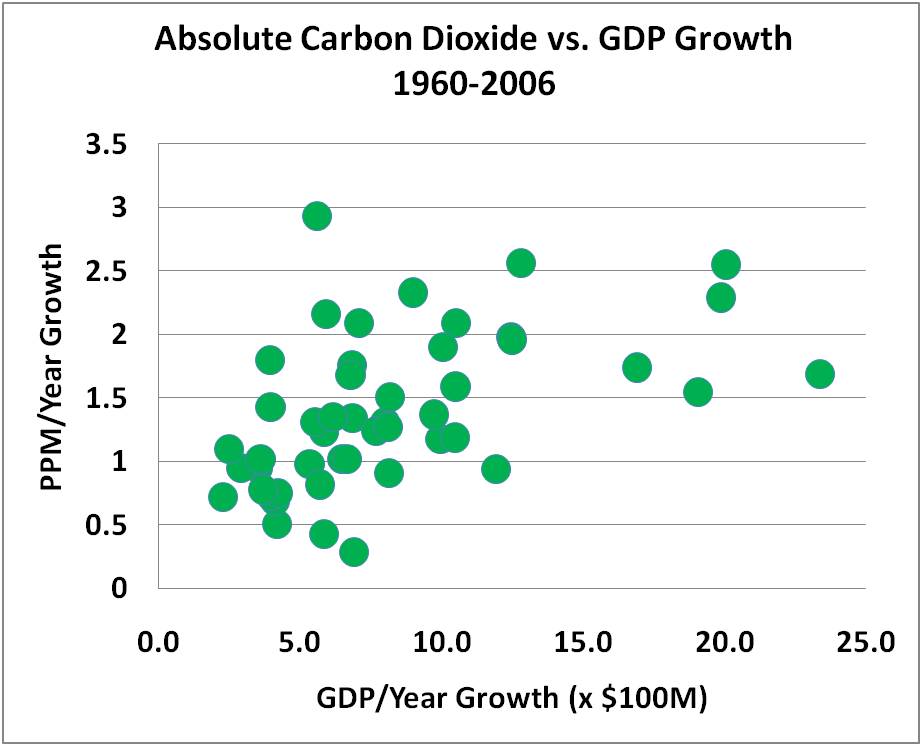
For 2007 and 2008, carbon dioxide increased by 2.2 and 1.7 ppm respectively, while corresponding GDP growth information is not yet available in the Maddison dataset. However, what should be clear from the historical data is that there is a wide range of concentration increases associated with different economic growth rates. This is to be expected, because not only is there variability in the ocean and land uptake, but there have been dramatic changes in the carbon intensity of energy and energy intensity of the economy have changed over time.
It seems quite premature, and even unjustified, to suggest the exhaustion of natural sinks, when the recent observations do not seem at all out of line with what has been seen previously.