January 29, 2009
Climate Science Infallibility Syndrome
When fighting political battles through science, scientists are at a distinct disadvantage. Unlike politicians and political advocates who can cherry pick and even change their arguments and justifications as they see fit (since that is what they are expected to), scientists’ claim to authority rests on the assertion that they have access to the truth. So they often enter political arenas explaining that their views are more true than their opponents, and thus on this basis their political agenda deserves to win out. The more strident the scientists appear in political debates the more compelling their grasp of truth appears to be. By contrast, changing one’s views or even acknowledging uncertainty, even if fundamental to how science progresses, is not an asset for scientists in the political arena.
But science can be fickle. The notion of what is true evolves in science, as new studies come in and new data, theories, and techniques are developed and advanced. Further, science rarely speaks with one voice, which also is quite normal and fundamental to how science actually works. The very process of science with all of its messiness and shades of gray does not lend it well to political battles, where issues are typically defined in black and white terms.
In the latest installment of the climate wars, a tempest in a teapot has blown up over a recent paper in Nature, which illustrates the perils of playing politics through science. In this case the political battle is over climate change and between the skeptics and their self-appointed enemies. The skeptics have in the past seized upon normal uncertainties and contradictory results in climate science to advance a political agenda. In response, their self-appointed enemies have asserted a sort of infallibility, claiming that such contradictions in the science have never actually existed. As might be expected in political battle, according to their self-appointed enemies, the skeptics have always been wrong about the science (politics) and their self-appointed enemies have always been right about the science (politics). The reason for this view is that any admission of uncertainties or contradictions in the science of climate change by the self-appointed enemies of the skeptics might give some aid and comfort to those nefarious skeptics with evil political agendas.
This long, boring, and detailed post tells the story of how the scientists at Real Climate over-reached in this political skirmish on the issue of cooling and then warming in Antarctica. But as is often said, it was not the overreach that was the problem as a mild corrective would have rendered it but a footnote. Instead it was the overreaction to the overreach that has damaged their credibility. Still as I write this, the battle continues to escalate. Let this story be a lesson in the perils of climate science infallibility syndrome.
The story begins with Steig et al. 2009, a paper just recently published that claims that Antarctica has warmed since 1957. Both Steig and co-author Drew Shindell have said in media interview that this warming is consistent with what one would expect from climate model projections. The paper has generated some controversy because it appears to contradict earlier claims by climate scientists that the cooling of Antarctica was consistent with what climate models have predicted. The controversy has been flamed by the fact that it appears that the same group of scientists – the authors of the blog Real Climate — are making the apparent contradictory claims at different points in time, as a matter of expedient intellectual gymnastics in the ongoing political war against the skeptics. This post explains the source of the confusion.
Let’s start at the beginning, or close enough. In 2002 Peter Doran, of the University of Illinois, and colleagues published a paper in Nature which suggested, according to Doran that “most of the [Antarctic] continent is cooling.” At the time, skeptics seized upon the results in cherry-pick fashion to suggest that a cooling Antarctica contradicted the theory of global warming due to greenhouse gases, a view that Doran certainly did not hold.
Flash forward to 2004, when Real Climate’s Gavin Schmidt and Eric Steig published a thoughtful and nuanced post on Real Climate explaining that what was going on in Antarctica was ambiguous and uncertain, citing the Doran article:
Long term temperature data from the Southern Hemisphere are hard to find, and by the time you get to the Antarctic continent, the data are extremely sparse. Nonetheless, some patterns do emerge from the limited data available. The Antarctic Peninsula, site of the now-defunct Larsen-B ice shelf, has warmed substantially. On the other hand, the few stations on the continent and in the interior appear to have cooled slightly (Doran et al, 2002; GISTEMP). At first glance this seems to contradict the idea of “global” warming, but one needs to be careful before jumping to this conclusion.
A rise in the global mean temperature does not imply universal warming. Dynamical effects (changes in the winds and ocean circulation) can have just as large an impact, locally as the radiative forcing from greenhouse gases. The temperature change in any particular region will in fact be a combination of radiation-related changes (through greenhouse gases, aerosols, ozone and the like) and dynamical effects. Since the winds tend to only move heat from one place to another, their impact will tend to cancel out in the global mean.
It is important to recognize that the widely-cited “Antarctic cooling” appears, from the limited data available, to be restricted only to the last two decades, and that averaged over the last 40 years, there has been a slight warming (e.g. Bertler et al. 2004. At present, it is not possible to say what the long term change over the entire last century or more has been. The lesson here is that changes observed over very short time intervals do not provide a reliable picture of how the climate is changing.
The issue apparently was still bothering Doran in April, 2006 when he had an op-ed in the New York Times bemoaning the fact that the “cooling Antarctica disproves global warming” argument was still being circulated, with his work often misrepresented at the center of the argument:
My research colleagues and I found that from 1986 to 2000, one small, ice-free area of the Antarctic mainland had actually cooled. Our report also analyzed temperatures for the mainland in such a way as to remove the influence of the peninsula warming and found that, from 1966 to 2000, more of the continent had cooled than had warmed. Our summary statement pointed out how the cooling trend posed challenges to models of Antarctic climate and ecosystem change.
Doran also noted, correctly in my view, that science does not always speak with one voice suggesting that representations of science would be wise to acknowledge uncertainties:
Another group of researchers who took a different approach found no clear cooling trend in Antarctica. We still stand by our results for the period we analyzed, but unbiased reporting would acknowledge differences of scientific opinion.
This last point is a lesson often ignored in political battles involving science. Upon publication of the op-ed Real Climate posted an approving comment, again emphasizing uncertainties and complexities:
As we discussed a while back (Antarctic cooling, global warming?), there is a lot of interesting stuff going on in Antarctica: the complexities of different forcings (ozone in particular), the importance of dynamical as well as radiative processes, and the difficulties of dealing with very inhomogeneous and insufficiently long data series. But like so many results in this field, it has become a politicized ‘talking point’, shorn of its context, that is mis-quoted and mis-used by many who should (and often do) know better.
Now forward to January, 2008, when Real Climate adopted a far less nuanced stance on the subject in a posting authored by Spencer Weart, which begins as follows:
Despite the recent announcement that the discharge from some Antarctic glaciers is accelerating, we often hear people remarking that parts of Antarctica are getting colder, and indeed the ice pack in the Southern Ocean around Antarctica has actually been getting bigger. Doesn’t this contradict the calculations that greenhouse gases are warming the globe? Not at all, because a cold Antarctica is just what calculations predict… and have predicted for the past quarter century.
Now this is a rather strangely worded passage. Weart begins by observing that:
we often hear people remarking that parts of Antarctica are getting colder
This obviously could be a reference to the Doran et al. study and the public discussion and misrepresentation of it. Weart invokes Antarctica “getting colder.” But then Weart changes his tense:
Doesn’t this contradict the calculations that greenhouse gases are warming the globe? Not at all, because a cold Antarctica is just what calculations predict… and have predicted for the past quarter century.
Instead of Antarctica getting “colder” he now says that Antarctica is “cold.” A normal reading of this in English would suggest that he means the same thing with both words — because when he says “doesn’t this” in the previous sentence — “this” is obviously refering to “getting colder”. Had he in fact meant something different by changing tense to “cold” from “colder” then he would be misleading his readers by suggesting one thing but saying another. I assume that Weart was not trying to deceive.
Weart later repeats the strange use of tense when he says that observations are consistent with models:
In the twenty years since, computer models have improved by orders of magnitude, but they continue to show that Antarctica cannot be expected to warm up very significantly until long after the rest of the world’s climate is radically changed.
Bottom line: A cold Antarctica and Southern Ocean do not contradict our models of global warming. For a long time the models have predicted just that.
The strange construction did not go unnoticed by Real Climate readers. One commentor, Pete. asked for a clarification:
I simply don’t understand the title of this blog “We Knew That”. I just looked at the IPCC AR4WG1 Summary. On Page 15 it shows Projections of Surface Temperatures. 2020-2029 show the Antarctic Warming by up to +1.0C. 2090-2099 shows a Warming in the Antarctic of around +3.0C to +4.0C.
Nowhere in this latest projection map from the IPCC, which I assume are from model predictions, is any cooling shown?
At the time I even registered some confusion in a comment on that thread:
There are a vast number of behaviors of the climate system that are consistent with climate model predictions, along the lines of your conclusion: “A cold Antarctica and Southern Ocean do not contradict our models of global warming.”
I have asked many times and never received an answer here: What behavior of the climate system would contradict models of global warming? Specifically what behavior of what variables over what time scales? This should be a simple question to answer.
Thanks!
Real Climate chose not to respond to either my or Pete’s requests for clarification on this point.
Now to the Steig et al. article. In December, 2008 Nature Feedback mentioned the Steig et al analysis as presented at the AGU in a blog posting, writing:
New research presented at the AGU today suggests that the entire Antarctic continent may have warmed significantly over the past 50 years. The study, led by Eric Steig of the University of Washington in Seattle and soon to be published in Nature, calls into question existing lines of evidence that show the region has mostly cooled over the past half-century.
This teaser evoked a response on Weart’s Real Climate thread from a confused but attentive reader, Mark Smith, who copied the Nature link with a couple of question marks. Eric Steig responded to Mark as follows:
[Response: That paper is in press, and I’m not allowed to comment on it per agreement with Nature until it is published. The claim that our result “calls into question existing lines of evidence that show the region has mostly cooled over the past half-century” is wrong though. Wait until the paper is published and I’ll say more.–eric]
Subsequently, Nature Climate Feedback added a clarification, presumably in response to Steig’s statement that the article was wrong:
New research presented at the AGU today suggests that the entire Antarctic continent may have warmed significantly over the past 50 years. The study, led by Eric Steig of the University of Washington in Seattle and soon to be published in Nature, calls into question existing lines of evidence that show the region has mostly cooled over the past half-century. [Update: To be more specific here, incomplete records previously suggested that the interior was cooling].
Here is where the climate scientists first show some signs of mixed messaging.
If “existing lines of evidence” suggest that the region “has mostly cooled over the past half century” and those lines of evidence are “consistent with” model predictions, then a new study that “called into question” those “existing lines of evidence” would have to either be inconsistent with the model predictions or make somewhat a mockery of the notion of consistency with models.
Let’s take a moment for fact checking.
First, is it the case that “existing lines of evidence that show the region has mostly cooled over the past half-century”?
Answer: While it may not have been a view universally held (and Nature does not say that it was), the Doran et al. study certainly presents this viewpoint. As Doran said, which is cited above, “most of the [Antarctic] continent is cooling”.
Second, is it the case that such continent-wide cooling was represented as being “consistent with” what the climate models had predicted?
Answer: Yes and no. On the one hand, Doran stated (as cited above) that the cooling presented challenges to model predictions, “Our summary statement pointed out how the cooling trend posed challenges to models of Antarctic climate and ecosystem change.” On the other hand, Weart’s posting at Real Climate indicated no contradiction between models and observations of cooling, writing (as cited above):
we often hear people remarking that parts of Antarctica are getting colder, and indeed the ice pack in the Southern Ocean around Antarctica has actually been getting bigger. Doesn’t this contradict the calculations that greenhouse gases are warming the globe? Not at all, because a cold Antarctica is just what calculations predict
It seems obvious that a cooling Antarctica can’t both pose challenges for models and also be exactly what they predict. Here at Prometheus Steig initially admitted not liking Weart’s formulation:
I have to admit I cringed when guest writer Weart wrote the article on RealClimate, which I didn’t get a chance to read first. I’m not sure what models he was talking about that said Antarctica should be cooling.
Steig later sought to clarify this admission:
All. I should clarify my point. When I said that “I cringed” I don’t mean that I thought there was anything wrong with Spencer’s article. I meant that I thought he wasn’t clear enough that he was referring to the models show a slower warming in Antarctica than e.g. in the Arctic, which was and remains the correct assessment of what the model show.
So Steig places himself in the uncomfortable position of viewing Weart’s article as “not clear enough” in saying what Steig thought should have been said and yet at the same time finding not “anything wrong” with it. Real Climate never attempted to address the basic lack of clarity or apparent contradictions in the Weart article until the Steig et al. paper came out, at which point they decided to take the stance that they had been repeating a single, consistent message all along, and this message was in fact consistent will all previous research.
Third, was Eric Steig correct when he claimed at Nature Climate Feedback that “The claim that our result “calls into question existing lines of evidence that show the region has mostly cooled over the past half-century” is wrong”?
Answer: Oddly, Eric appears to be misrepresenting his own paper here. Here is what Steig et al. write in Nature:
Here we show that significant warming extends well beyond the Antarctic Peninsula to cover most of West Antarctica, an area of warming much larger than previously reported.
They further write:
Our reconstructions show more significant temperature change in Antarctica (Fig. 2), and a different pattern for that change than reported in some previous reconstructions 5, 7.
Reference 5, not surprisingly, is Doran et al. 2002 from Nature, cited above. It is not clear to me how Nature’s reporting that Steig et al. calls into question earlier lines of evidence when Steig et al. themselves characterize their results as being a “different pattern” and an areal extent “different” than previous studies, citing Doran specifically.
In a post on the study at Real Climate (with a not so subtle political allusion in its title) Steig has this puzzling statement:
Our results do not contradict earlier studies suggesting that some regions of Antarctica have cooled. Why? Because those studies were based on shorter records (20-30 years, not 50 years) and because the cooling is limited to the East Antarctic.
This statement is puzzling in several respects. Forst, Doran et al. covers a period of 1966-2000, which is 35 years, which is not within the range of 20-30 cited by Steig. But the further point is, so what? If you look at Steig et al.s own data, it seems clear (see the top panel below, for East Antarctica, which is actually most of the continent) that Steig et al. indicate a warming from 1966 to 2000 anyway. So the length of record appears to be irrelevant. Antarctica cannot be both cooling and warming over this period. To remove all ambiguity, if Eric or colleagues with to present the subset of their data for 1966 to 2000, we’ll post it up here.
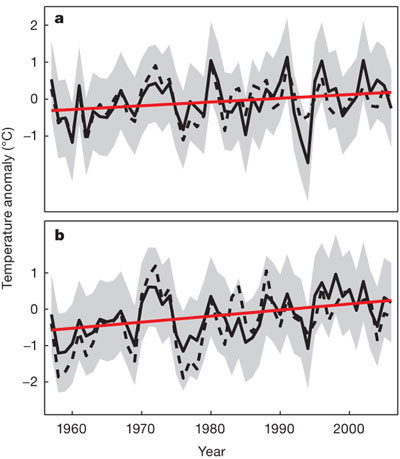
More importantly, Steig represents their results “do not contradict earlier studies” and yet in the text of his paper he writes that his results “show more significant temperature change” and “a different pattern for that change” than earlier studies. This suggests to me a contradiction. Bt I suppose there is plenty of room for semantics about what it means to “contradict” and to be “different than.” But the plain English usage suggests that the new study is different than earlier studies (and hence worth publishing as a cover story in Nature). And, I should point out that such contradictions are perfectly normal in science. They are inconvenient in politics., when political arguments have been framed in terms of scientific certainties
Bottom Line
This is not a high point for Real Climate, which advertises itself as giving the straight scoop on climate science. The reality is that the straight scoop is sometimes confusing and contradictory, and views can change over time. But in the battle with the skeptics – which is not a scientific but a political battle – there can be no room to give even an inch. Climate science, it seems, must be infallible. This infallibility syndrome leads to over reach and then, ultimately, a loss of credibility.
Here are the facts of this case:
1. Research in the early parts of this decade suggested that most of Antarctica was cooling, most notably, Doran et al. in Nature.
2. This was indeed puzzling for some scientists, especially in relation to what models predicted.
3. In early 2008, Real Climate went out on a limb with a poorly worded (at best) or misleading (at worst) post, explaining (or, if you’d like, implying) that cooling was consistent with what scientists have be expecting all along.
4. With Steig et al., new research suggests that earlier views of cooling and the patterns of temperature over Antarctica are to be interpreted, if not replaced, with new findings that are different than those that existed before – a process quite normal to science.
5. To preserve the appearance of infallibility a vocal group of climate scientists is now on the warpath, probably doing far more damage to their credibility than had they simply said, “Yeah, the new research is a bit different, and we probably overstepped in our commentary once.”
As I said at the outset, the scientists are playing politics on an uneven playing field.