September 5, 2008
PIK on “Dangerous Assumptions”
[UPDATE: A colleague just pointed out the Prof. Edenhofer is the newly elected co-chair of the IPCC WGIII.]
Last spring Tom Wigley, Chris Green and I published an article in Nature (PDF) suggesting that the IPCC (and by extension, similar assessments) assumes in scenarios of future emissions trajectories that a large amount of future emissions reductions would occur automatically, without any specific climate policies. You can see the amount of this assumed emissions reduction in the following figure indicted by the light blue portion of the stacked bars (the green portion shows an allowable amount of emissions consistent with stabilization at about 500 ppm, leaving the red amount needed to be addressed by climate policy).
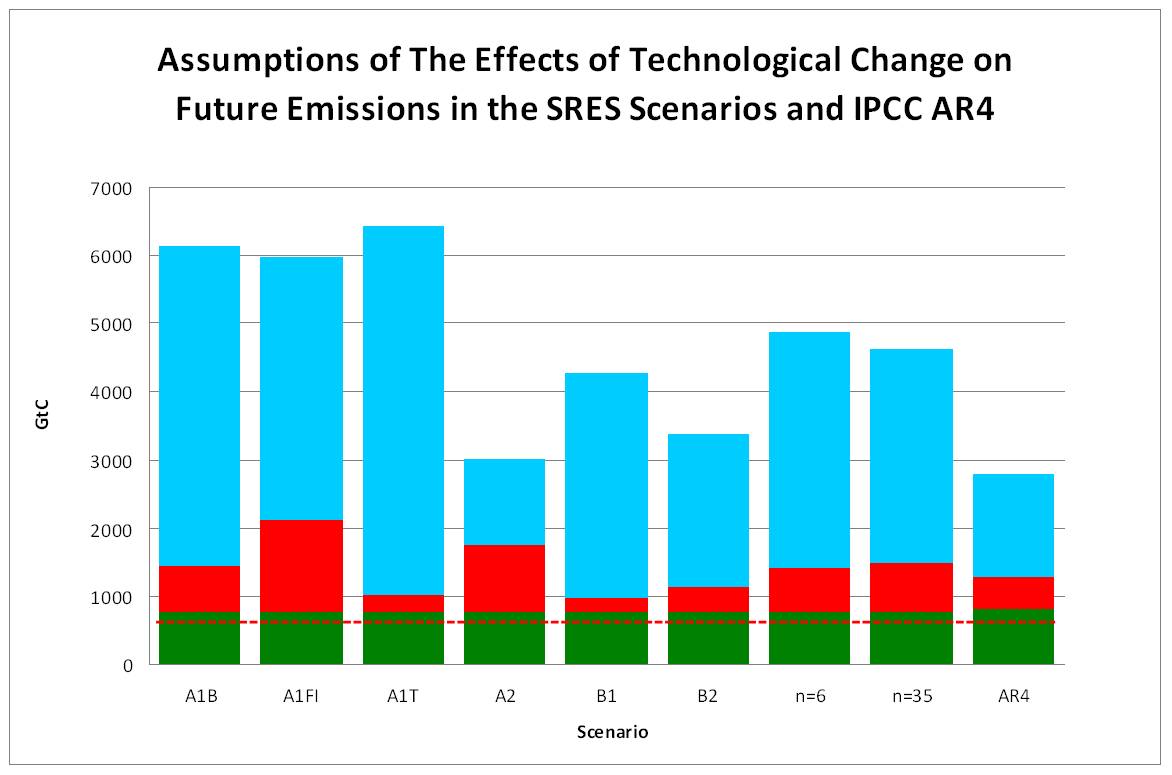
A group of scholars at the Potsdam Institute for Climate Impact Research (PIK) has been kind enough to prepare a response to our piece. The PIK team’s (Ottmar Edenhofer, Brigitte Knopf, Jan Steckel, Gunnar Luderer) article can be found here in PDF. They open with a few strong statements:
In their recent Nature article Pielke et al. (2008) convey as a their key message that the IPCC dramatically underestimates the socio-economic effort it would take to transform the 21st century non-policy – high emission path into a policy-induced low-emission path. Thus, the core statement of working group 3 in the Fourth Assessment Report of the IPCC seems to begin to totter – that an ambitious climate policy can be pursued with the already existing technologies. What the article of Pielke et al. does not explicitly say but suggests implicitly is that the cost estimates of the IPCC would then also be just as unrealistic as the estimation of the technical and economic challenge. Is the optimistic message that the IPCC announced in 2007 to the whole world finally unfounded? Is the challenge greater than assumed, is climate policy now more expensive than alleged? Did the IPCC finally mislead policy makers? Is the IPCC eventually not the “honest broker” between science and politics and pursues own politics with the authority of science?
With their comment “Dangerous Assumptions”, the authors further fostered the suspicion that the IPCC did not provide a down-to-earth analysis of the options and limits of climate policy. The bomb that the authors seemingly drop can however be easily deactivated.
I like their analogy of a “bomb”, for the following reason. They don’t imply that our analysis is wrong (i.e., there is no bomb), simply that it need to be “deactivated”. In fact, a close look at the PIK analysis shows far more area of agreement with our analysis than disagreement. Where there is disagreement, there is apparent misunderstanding. The “bomb” is still ticking.
The PIK team agrees with much of the core of our analysis:
. . . we can agree with Pielke et al. that there are definitely alarming developments in China that suggest that the autonomous technical progress may be slower in the future than the historical trend . . .
. . . In the light of Pielke et al. it needs to be discussed if there will be a break in the development of the worldwide energy system compared to the historical trend. . .
. . . The development of carbon intensity is therefore indeed worrying. . .
. . . It is therefore absolutely unquestionable that the assumptions about the autonomous technical progress considerably influence the mitigation costs.
The PIK team unfortunately builds and proceeds to knock down a straw man when they assert:
Pielke et al. therefore exaggerate immoderately if they assume that the hypothetic scenario of the IPCC, in which the carbon and energy intensity is frozen on today’s level, is the most likely future scenario. . . For the estimation of the future trend, it is however absurd to construct a business-as-usual-scenario that does not produce any technical progress
They write “if they assume” presumably because we said nothing of the sort in our paper. We suggested using a “frozen technology” baseline simply because in an analysis it forces all assumptions of future technological innovation out into the open. The “frozen technology” baseline is an analytical tool, not a prediction about the future, and certainly is not a “business as usual” scenario. One of the best indications that critics accept our technical analysis is the misplaced allegation that our “frozen technology” baseline is a projection. This is just a misreading of our paper. Here is how we describe the “frozen technology” baseline in the original paper (emphasis added):
We also use the emissions-scenario building blocks in our analysis, but adopt a frozen-technology baseline to reveal the full challenge of decarbonization. Using this baseline also reveals the huge amount of emissions-reducing technological change built into the SRES and similar scenarios.
Interestingly the PIK paper concludes with a perspective entirely consistent with our own:
The real question for scientists is: What are the implications for climate policy when the world economy is now facing a renaissance of coal. This debate is urgent and timely.
We said the following:
Because of these dramatic changes in the global economy it is likely that we have only just begun to experience the surge in global energy use associated with ongoing rapid development.
Virtually all scenarios of future emissions fail to reflect the possibility of such changes, which is why it is important to move into the future with a fully appreciation of the uncertainties and possibilities — even if this leads to the uncomfortable knowledge that the mitigation challenge could be larger than that presented by the IPCC and others. While the PIK critique of our paper is welcome, they have done little to defuse the bomb, but rather, made it a bit harder to hear it ticking.