July 28, 2008
Draft CCSP Synthesis Report
The U.S. Climate Change Science Program has put online for public comment a draft version of its synthesis report ( here in PDF), and I suppose the good news is that it is a draft, which means that it is subject to revision. But what the draft includes is troubling in several respects.
First, the report adopts an approach to presenting the science more befitting an advocacy group, rather than a interagency science assessment. The report ignores the actual literature on economics and policy, choosing instead to present fluffy exhortations about the urgency of action and reducing emissions. I can get that level of policy discussion from any garden variety NGO, for $2 billion per year over the past 18 years, I would expect a bit more.
The report opens with this language:
The Future is in Our Hands
Human-induced climate change is affecting us now. Its impacts on our economy, security, and quality of life will increase in the decades to come. Beyond the next few decades, when warming is “locked in” to the climate system from human activities to date, the future lies largely in our hands. Will we begin reducing heat-trapping emissions now, thereby reducing future climate disruption and its impacts? Will we alter our planning and development in ways that reduce our vulnerability to the changes that are already on the way? The choices are ours.
Pretty thin stuff. The report speaks of urgency:
Once considered a problem mainly for the future, climate change is now upon us. People are at the heart of this problem: we are causing it, and we are being affected by it. The rapid onset of many aspects of climate change highlights the urgency of confronting this challenge without further delay. The choices that we make now will influence current and future emissions of heat-trapping gases, and can help to reduce future warming.
It is not within the Congressional mandate of the CCSP to tell policymakers when to act or what goals to pursue. The report does have some limited discussion of options, which would be great (and within the mandate) if it were comprehensive and scientifically rigorous. Unfortunately, it is neither.
Despite recognizing that some adaptation will be necessary, and discussing adaptive responses in the text, the report has a strong bias against adaptation in favor of mitigation:
The more we mitigate (reduce emissions), the less climate change we’ll experience and the less severe the impacts will be, and thus, the less adaptation will be required. . . Despite what is widely assumed to be the considerable adaptive capacity of the United States, we have not always succeeded in avoiding significant losses and disruptions, for example, due to extreme weather events. There are many challenges and limits to adaptation. Some adaptations will be very expensive. We will be adapting to a moving target, as future climate will not be stationary but continually changing. And if emissions and thus warming are at the high end of future scenarios, some changes will be so large that adaptation is unlikely to be successful.
A large body of work, some of which I’ve contributed, indicates that adaptation and mitigation are not tradeoffs, but complements. Somehow this literature escaped the thorough review done by the authors of this report.
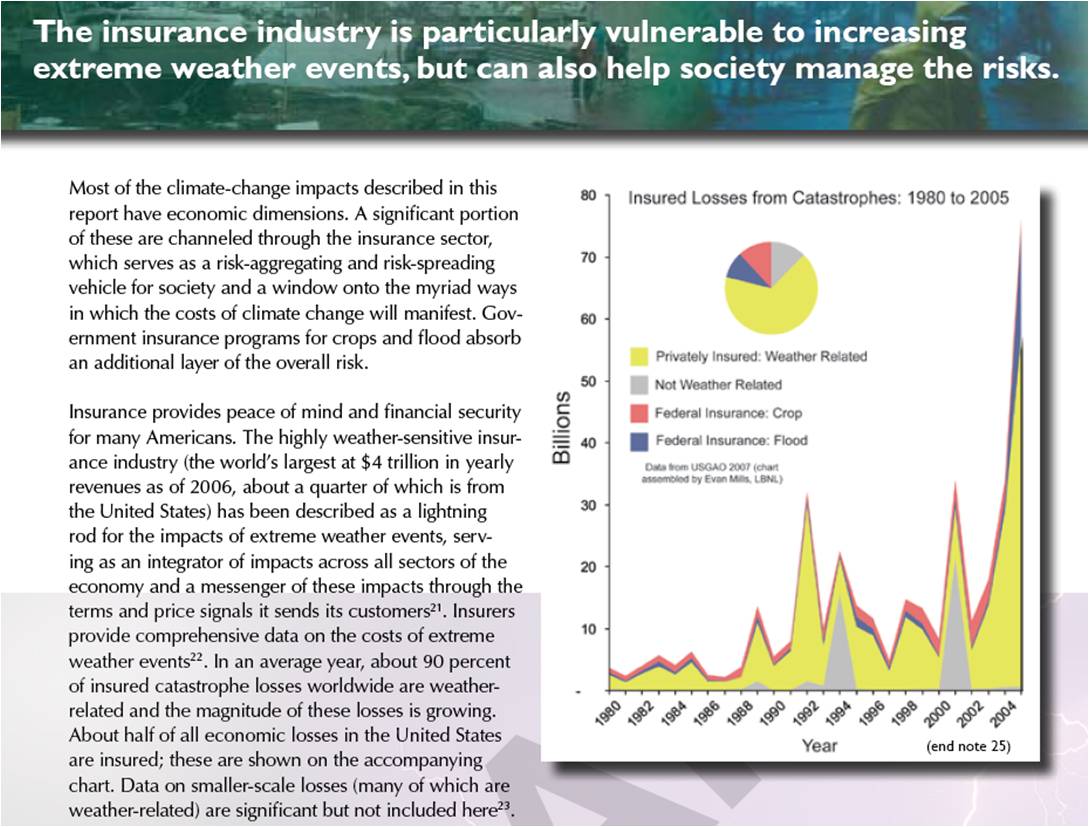
The report claims to be focused on bringing together the “best available science.” However in the area of my expertise, disasters and climate change, the report is an embarrassment. For example, once again, it uses the economic costs of disasters as evidence of climate change and its impacts, as shown in the following figure from the report.
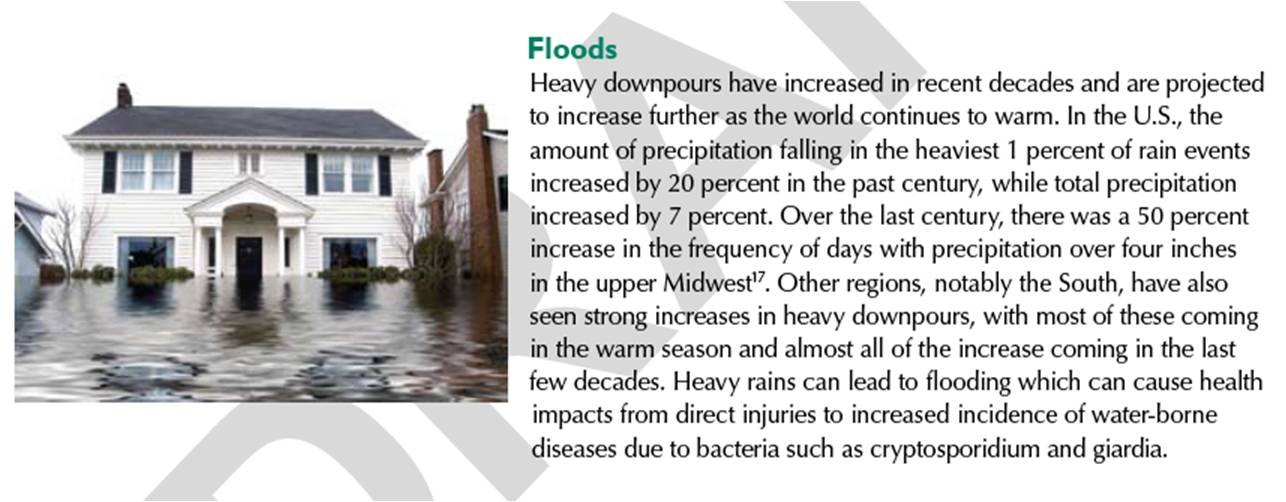
Then, later in the report it discusses increasing U.S. precipitation under the heading “Floods” and next to a picture of a flooded house (below). However, in the U.S. there has been no increase in streamflow and flood damage has decreased dramatically as a fraction of GDP. Thus the report reflects ignorance on this subject or is willfully misleading. Neither prospect gives one much confidence in a government science report.
In short, in areas where I have expertise, at best the reporting of the science of climate impacts in this report is highly selective. Less generously it is misleading, incorrect, and a poor reflection on the government scientists whose names appear on the title page, many of whom I know and have respect for. The report asks for comments during the next few weeks, and I will submit some reactions, which I’ll also post here.
So why does the report have such an advocacy focus and rely on misleading arguments?
One answer is to have a look to the people chiefly responsible for the editing of the report, and also the section on natural disasters, where one person’s views are reported almost exclusively to any others.
Perhaps it is time to rotate control of U.S. government “science” reports to some new faces?