May 29, 2008
Does the IPCC’s Main Conclusion Need to be Revisited?
Yesterday Nature published a paper by Thompson et al. which argues that a change in the observational techniques for taking the temperatures of the oceans led to a cold bias in temperatures beginning in the 1940s. The need for the adjustment raises an interesting, and certainly sensitive, question related to the sociology and politics of science: Does the IPCC’s main conclusion need to be revisited?
The Nature paper states of the effects of the bias on temperature measurements:
The adjustments immediately after 1945 are expected to be as large as those made to the pre-war data (.0.3 C; Fig. 4), and smaller adjustments are likely to be required in SSTs through at least the mid-1960s.
Thompson et al. do not provide a time series estimate on the effects of the bias on the global temperature record, but Steve McIntyre, who is building an impressive track record of analyses outside the peer-review system, discussed this topic on his weblog long before the paper appeared in Nature, and has proposed an adjustment to the temperature record (based on discussions with participants on his blog). Steve’s adjustment is based on assuming:
that 75% of all measurements from 1942-1945 were done by engine inlets, falling back to business as usual 10% in 1946 where it remained until 1970 when we have a measurement point – 90% of measurements in 1970 were still being made by buckets as indicated by the information in Kent et al 2007- and that the 90% phased down to 0 in 2000 linearly.
The effects of McIntyre’s proposed adjustments (on the UKMET global temperature record) are shown in the following figure.
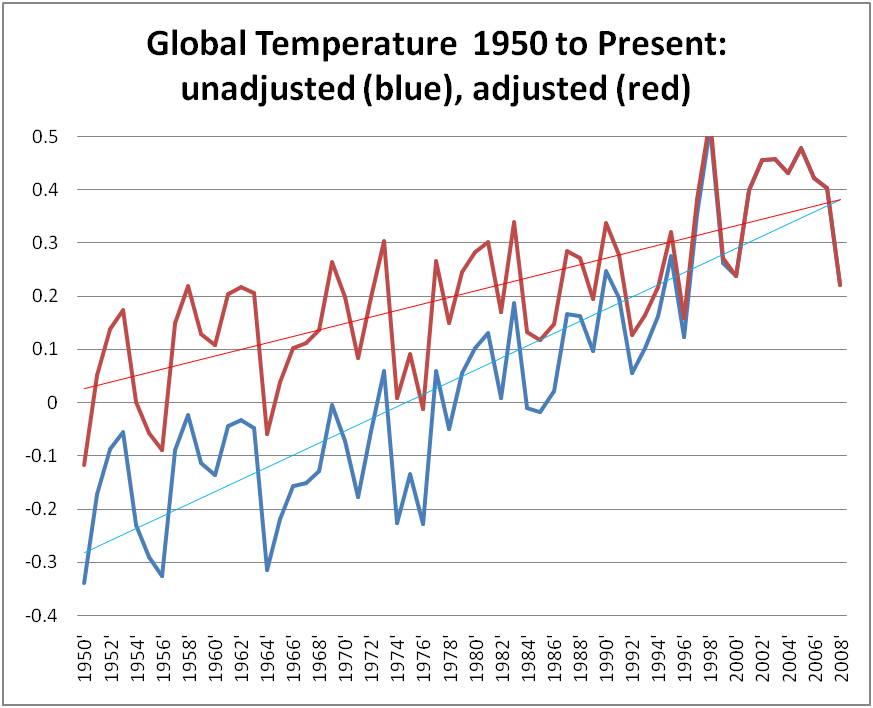
Other adjustments are certainly plausible, and will certainly be proposed and debated in the literature and on blogs (McIntyre discusses possible implications of the adjustments in this post.). But given how much research has been based on the existing global temperature record, it seems likely that many studies will be revisited in light of the Nature paper. In a comment in Nature that accompanies Thompson et al., Forest and Reynolds suggest:
The SST adjustment around 1945 is likely to have far-reaching implications for modelling in this period.
In the figure above, the trend in the unadjusted data (1950-present) is 0.11 Deg C per decade (slightly lower than reported by IPCC AR4, due to the recent downturn), and after the adjustments are applied the trend drops by just about half, to 0.06 Deg C per decade.
And this brings us to the IPCC. In 2007 the IPCC (PDF) concluded that:
Most of the observed increase in global average temperatures since the mid-20th century is very likely due to the observed increase in anthropogenic greenhouse gas concentrations
I interpret “mid-20th century” to be 1950, and “most” to be >50%. This means that the 2007 IPCC attributed more than 0.06 Deg per decade of the temperature increase since 1950 to increasing greenhouse gases. But we know now that the trend since 1950 included a spurious factor due to observational discontinuities, which reduces the entire trend to 0.06. So logically, if the proposed adjustment is in the ballpark, it would mean that one of the following statements must be true in order for the IPCC statement to still hold:
A. The entire trend of 0.06 per decade since 1950 should now be attributed to greenhouse gases (the balance of 0.06 per decade)
B. Only >0.03 per decade can be attributed to greenhouse gases (the “most” from the original statement)
C. The proposed adjustment is wildly off (I’d welcome other suggestions for an adjustment)
D. The IPCC statement needs to be fundamentally recast
So which is it?
PS. To ensure that this blog post is not misinterpreted, note that none of the mitigation or adaptation policies that I have advocated are called into question based on the answer that one gives to the question posed in the title.