January 17, 2008
New Paper on Normalized Hurricane Damages
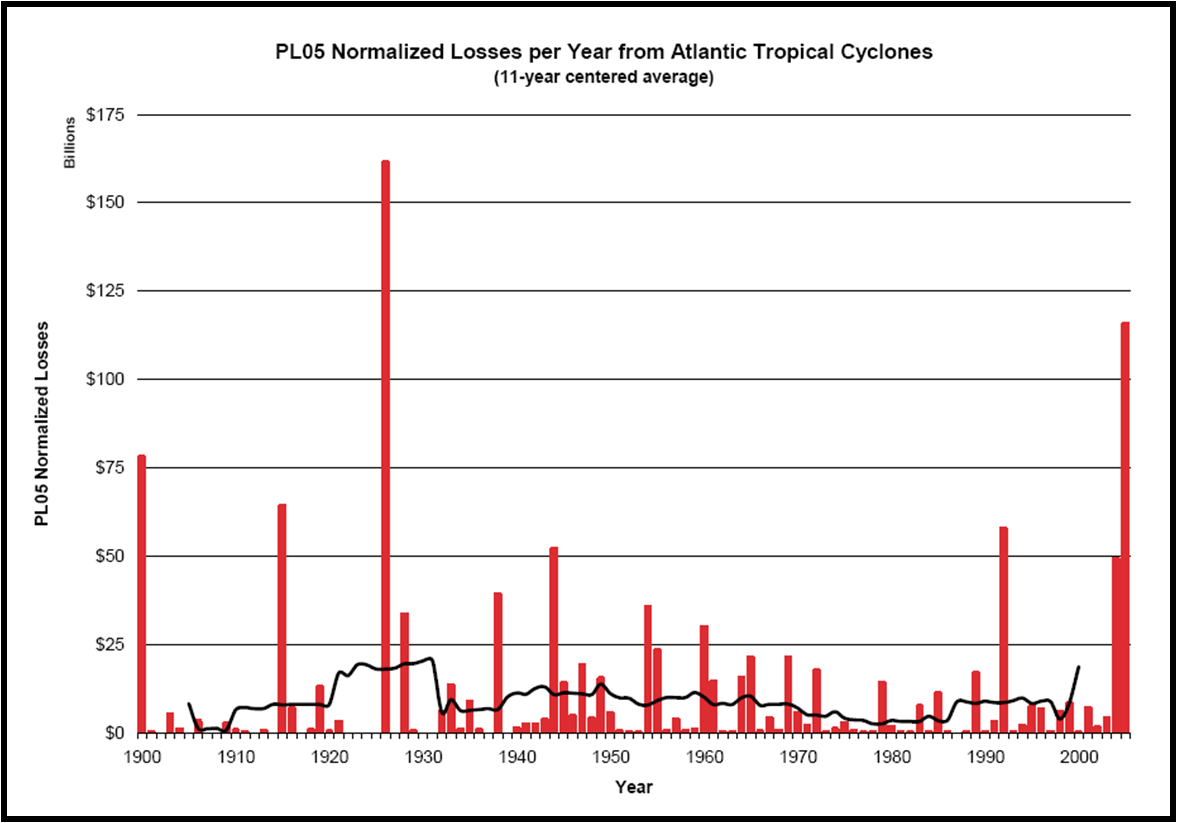
Our paper on normalized hurricane damages 1900 to 2005 has now been published. By “normalized” we mean taking damages as recorded in the year that they occurred in that year’s dollars, and adjusting them to account for societal changes such as population growth, building stock, tangible wealth, and inflation. The figure above shows the results of one of the two approaches to normalization presented in our paper.
The full paper can be found at the link below and an Excel dataset can be found here.
Pielke, Jr., R. A., Gratz, J., Landsea, C. W., Collins, D., Saunders, M., and Musulin, R., 2008. Normalized Hurricane Damages in the United States: 1900-2005. Natural Hazards Review, 9:29-42. (PDF)
A few brief comments follow.
For those who might be interested in the debate over hurricanes and global warming, there is nothing added to the debate from this paper. Here is what we say that is most relevant:
Pielke and Landsea (1998) found no trends in normalized losses, a finding subsequently replicated by Katz (2002). Recent analyses of longitudinal geophysical data find that there are no trends on hurricane frequency and intensity at U.S. landfall (see, Landsea 2005; Emanuel 2005; Landsea 2007). Because the normalization methodology is subject to assumptions, differences in which can lead to significant changes in results, there is general agreement that normalized data are in general not the best first place to look for changes in underlying geophysical variables, and such changes are best explored using the geophysical data directly (cf. Höppe and Pielke 2006). However, when climate trends or variability have sufficiently large effects on losses, they can be detected in damage data (e.g., Pielke and Landsea 1999).
The two normalized datasets reported here show no trends in either the absolute data or under a logarithmic transformation: the variance explained by a best fit linear trend line = 0.0004 and 0.0003 respectively for PL05, and 0.0014 and 0.00006 respectively for CL05. The lack of trend in twentieth century normalized hurricane losses is consistent with what one would expect to find given the lack of trends in hurricane frequency or intensity at landfall. This finding should add some confidence that, at least to a first degree, the normalization approach has successfully adjusted for changing societal conditions. Given the lack of trends in hurricanes themselves, any trend observed in the normalized losses would necessarily reflect some bias in the adjustment process, such as failing to recognize changes in adaptive capacity or misspecifying wealth. Because we do not have a resulting bias suggests that any factors not included in the normalization methods do not have a resulting net large significance.
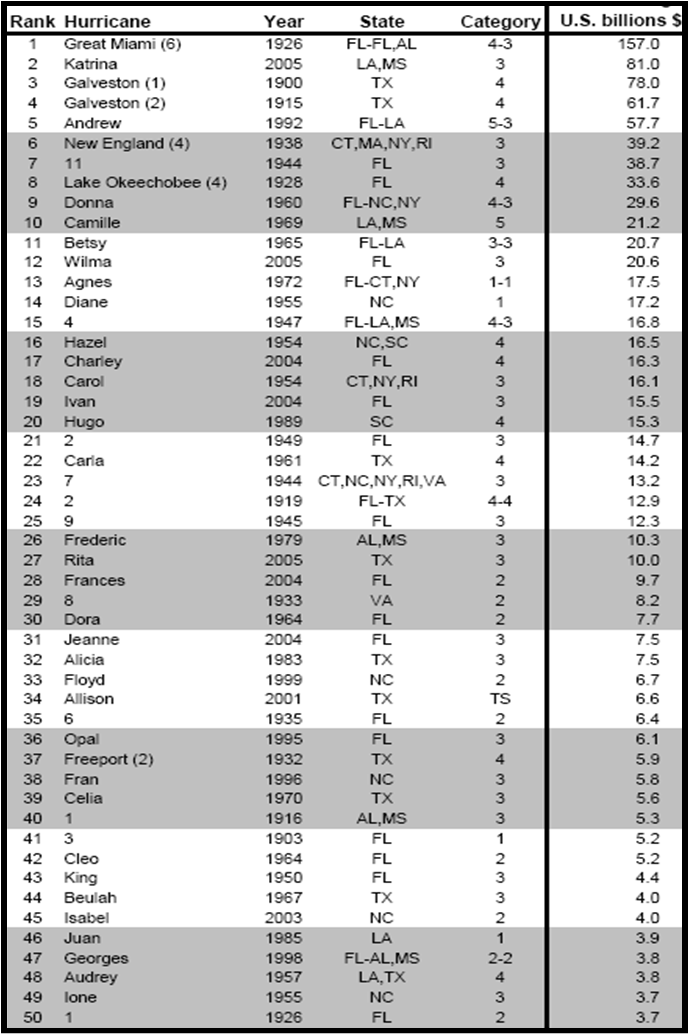
Below is an image showing the top 50 storms for one of the normalization methods. For the details on the methods and a whole bunch of analysis, please see the paper.