April 11, 2007
This is Just Embarassing
The Figure below is found in the IPCC WG II report, Chapter 7, supplementary material (p. 3 here in PDF). I am shocked to see such a figure in the IPCC of all places, purporting to show something meaningful and scientifically vetted. Sorry to be harsh, but this figure is neither. [Note: The reference (Miller et al. 2006) is not listed in the report (pointers from readers would be welcomed).]
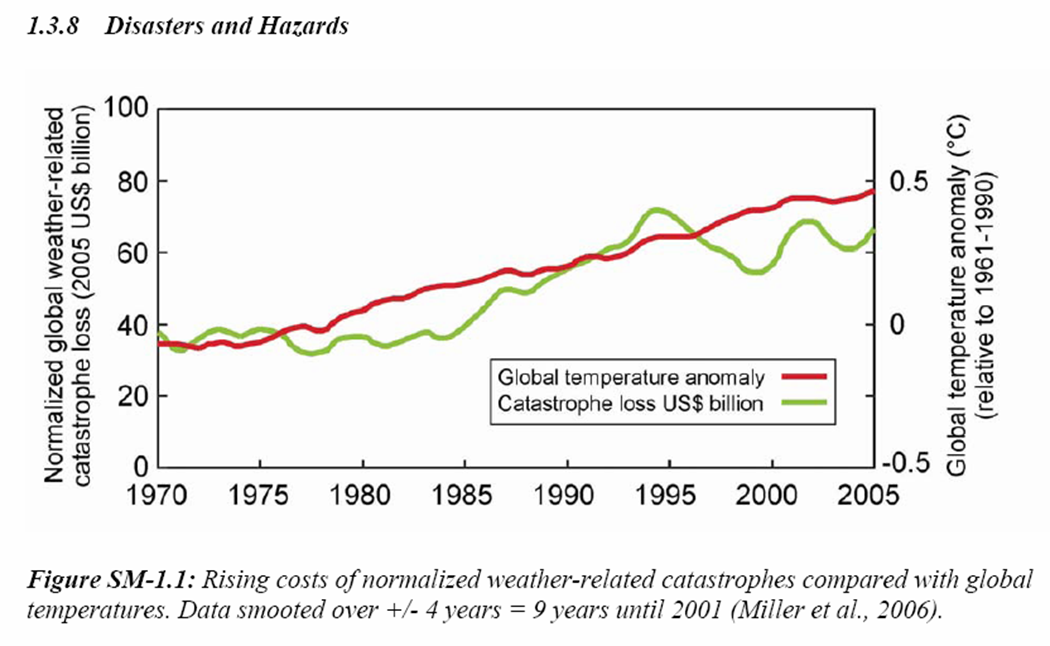
I am amazed that this figure made it past review of any sort, but especially given what the broader literature on this subject actually says. I have generally been a supporter of the IPCC, but I do have to admit that if it is this sloppy and irresponsible in an area of climate change where I have expertise, why should I have confidence in the areas where I am not an expert?
Addendum, a few of the many problems with this figure:
1. Global average temperatures do not cause disaster losses, extreme events cause disasters, mostly floods and tropical cyclones.
2. if you can’t attribute disaster losses regionally to changes in extremes, then you can’t do it globally with a metric only loosely (at best) related to extremes.
2. A 9-year smoothing in a 35 year record?
3. The IPCC has said that 30 years is not sufficient for such an attribution analysis, a 35 year record with 4 degrees of freedom probably isn’t either.
4. The Muir-Wood global dataset (if that is what is used) has huge error bars not noted here. Any global analysis should be matched with a regional summation.
5. The Muir-Wood dataset, without error bars, leads to opposite conclusions using a longer record to 1950. Why didn’t they show that? I wonder . . .
6. Studies of floods and hurricanes at the regional level, around the world, do not support a relationship of average global atmospheric temperature and disaster losses.
7. A consensus conference with experts around the world came to very different conclusions. What happened to the importance of consensus?
A more comprehensive synthesis can be found here:
Pielke, Jr., R.A., 2006. Seventh Annual Roger Revelle Commemorative Lecture: Disasters, Death, and Destruction: Making Sense of Recent Calamities, Oceanography, Special Issue: The Oceans and Human Health, Vol. 19, No. 2, pp. 138-147. (PDF)