February 18, 2007
Al Gore 2008, Part 2: A Comparison with the 2004 Evangelical Wedge
Last Friday I speculated that Al Gore will win the 2008 presidency in no small part due to the emergence of climate change as a wedge issue. A wedge issue well used in a political campaign will serve to split your opposition’s base and lead to a turn-out advantage among those motivated to vote. As a Pew Research analysis explained:
In electoral politics, however, what often matters most in measuring an issue’s potential impact is not whether a great many people care about it, but whether even a relatively small number care about it enough to base their vote on it. Indeed, the classic “wedge issue” is one that draws more of one kind of partisan than another to the polls.
So to explore this issue further I thought I’d compare the climate issue to evangelicals in the population. In the 2004 election the mobilization of evangelical voters was widely attributed as a successful strategy for George W. Bush. Here is what I found.
First, I gathered data on the self-described proportion of voters who call themselves ‘evangelical” from a poll taken in 2003-200 by the Annenberg Center (here in PDF). The following graph, left panel, compares the ranking of Evangelical voters with rank in percentage of 2004 presidential vote received by George W. Bush. Note that data was available for only 34 states. The right panel repeats the graph I presented in the earlier Gore post comparing the ranking of per capita CO2 emissions with rank in percentage of 2004 presidential vote received by George W. Bush.
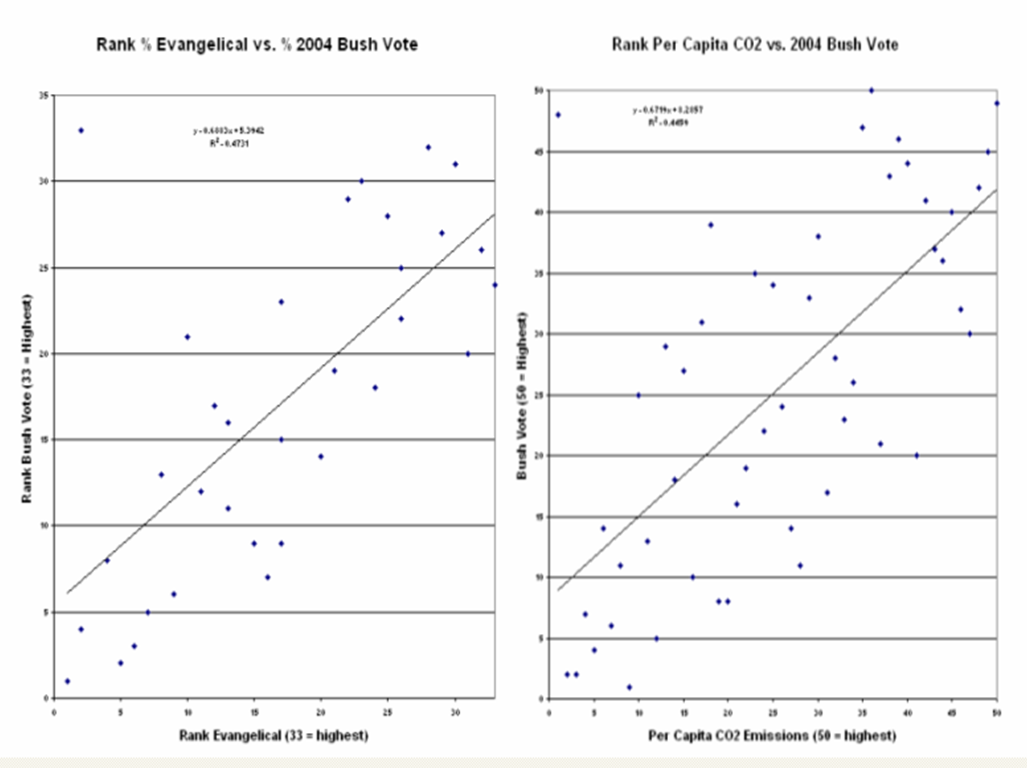
The rank correlation between evangelicals and Bush vote is 0.69. Recall that it was 0.67 between per capita CO2 and Bush vote. Very interesting! (Note Ohio and Florida in that swing-state zone.)
Now compare the distribution of states in the following chart, color coded to represent the vote outcome in the 2004 election.
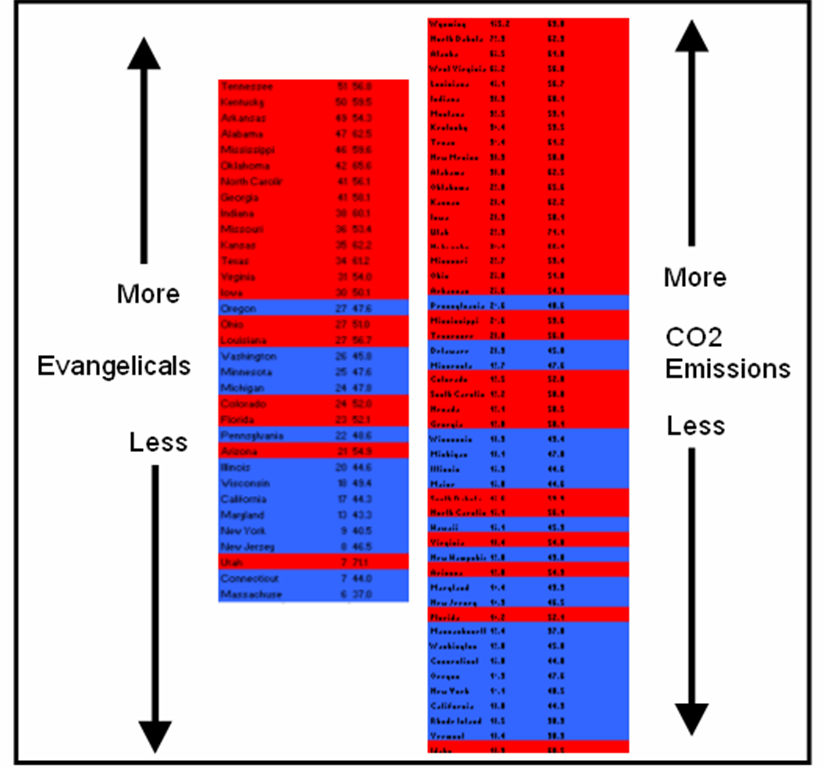
So what should you take from this comparison? If evangelical issues did indeed serve as a “wedge issue” in 2004 to the benefit the Republicans and George W. Bush, then the baseline conditions for the climate issue leading to 2008 suggest that it is equally amenable to exploitation for political gain among the Democrats, but particularly (and perhaps uniquely) for Al Gore.