November 24, 2006
Class Copenhagen Consensus Exercise: Feedback Requested
This Post Will Stay at the Top through 24 Nov, New Posts Will Still Appear Below
This semester in my graduate seminar Policy, Science, and the Environment we have spent a good share of the semester replicating and critiquing the Copenhagen Consensus exercise. With this post we’d like to solicit some feedback on the class term projects reporting and justifying their results
For those of you unfamiliar with the Copenhagen Consensus, its homepage describes its efforts as follows:
The Copenhagen Consensus Center (CCC) is a center under the auspices of the Copenhagen Business School. Through the commissioning and conveying of research, we work to improve the foundation for prioritizing between various efforts to mitigate the consequences of the World’s biggest challenges. In particular we focus on the international community’s effort to solve the World’s biggest challenges and how to do this in the most cost-efficient manner.
The idea is simple, yet often neglected. When financial resources are limited you need to prioritize your effort. Everyday, from policymakers to business leaders, at all levels, priorities are made between investing in one project and not another. However, many times, and particularly at the political level, decisions on priorities are made not based on facts, science or calculations but on which issue gets the most media coverage or is most politisized. The Copenhagen Consensus approach works to improve the foundation of knowledge, to get an overview of research and facts within a given problem, so that the prioritizing of efforts to solve this problem is based on evidence and is comparable with solutions across problems.
We are focusing on repeating the Copenhagen Consensus analysis in my class. This is the first time I’ve attempted this exercise, so this year I am very fortunate to have an extremely hard-working and thoughtful set of students in my class. Most importantly they have been extremely gracious in playing along as guinea pigs with a complete redesign of this course.
Here is what we’ve done. In our class we divided up into four groups – the Wolfpack, Troika, Great Danes, and the Savvy World Affairs Troubleshooters (SWAT). The first task for each group was to identify the two most important topics that were not on the Copenhagen Consensus list of 10 world problems. Each group presented two subjects and the students then voted among the recommendations to identify the two we would add to the list. We added Energy and Land Degradation.
The next task for the groups was to allocate $50 billion among the now 12 issue areas. Their assignment was to produce an allocation as well as a justification for their allocation. We have spent much of the semester focused on two tasks. One was learning from each other about the substantive issues involved with each problem area. The second was discussing the nature of cost-benefit analysis as a tool for producing information relevant to establishing priorities. We focused in particular on valuing human lives and discounting.
In producing their allocations and justifications, the groups were free to use whatever approach or method that they saw fit. We are posting the group reports here online to stimulate some feedback from our readers to the class on their reports. Note that the dictator professor disallowed efforts to spend the money over time or investing it in hopes of gaining a larger return, among other rules put in place to simplify and standardize the assignement. You will find a range of approaches to the allocation and a range of results.
Great Danes final report webpage
Troika final report webpage
SWAT final report webpage
Wolfpack final report webpage
Here is a spreadsheet summarizing the group allocations and comparing the class averages to three exercises run by the Copenhagen Consensus in 2004, 2006, and by the UN.
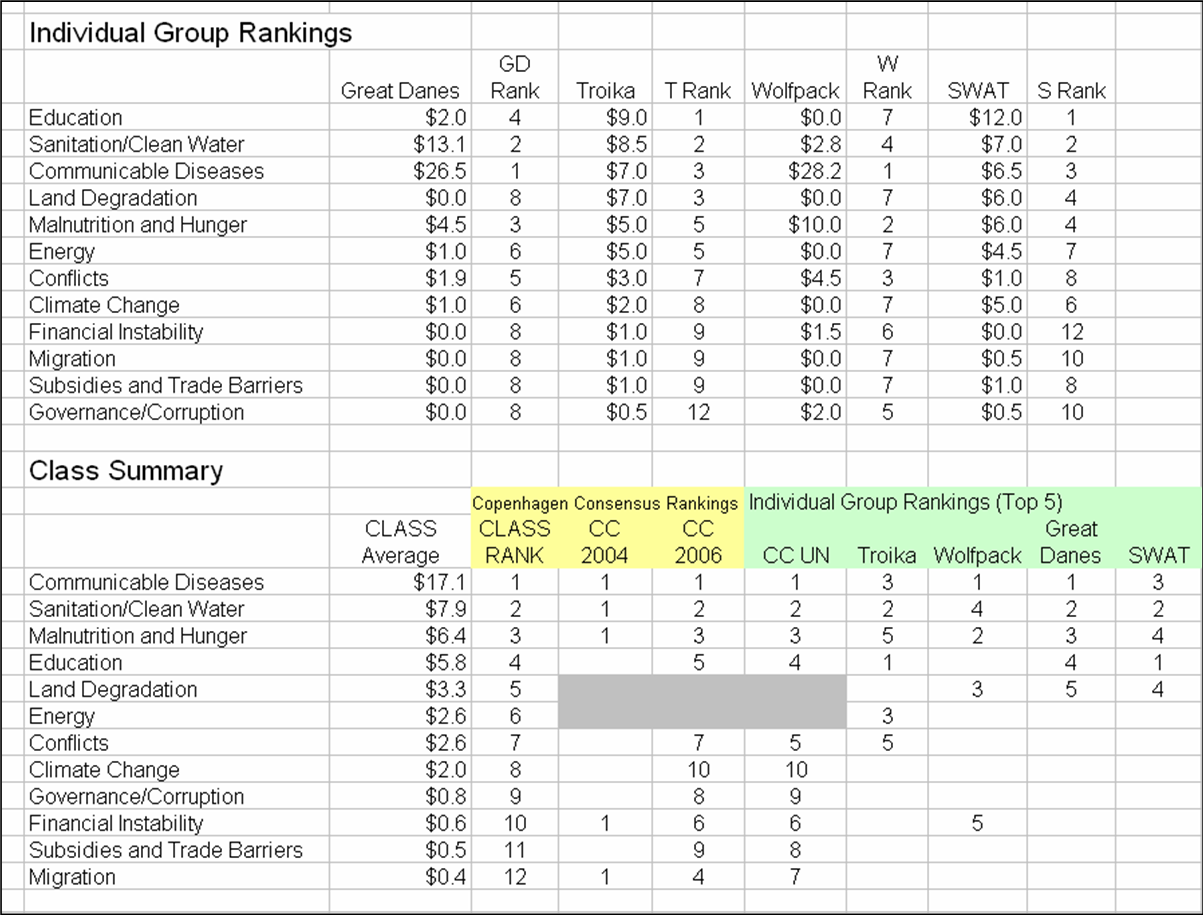
Whether or not you agree with their allocations, we would find useful any feedback on the group reports. How understandable are they? Are their arguments well supported and well justified? Are their reports credible?
It is a lot of work to read through the class projects, so we are grateful for whatever responses that our readers provide.
In closing, I wish to emphasize that in posting the reports the class is very interested in feedback but also wanted me to emphasize that many of the students are uncomfortable with the notion of cost-benefit analysis, and a few simply reject it as a legitimate basis for decision making altogether. We use the Copenhagen Consensus exercise as a pedagogical tool, not as an endorsement of the approach as a means of setting priorities. If I had $50 billion to spend, I certainly wouldn’t allocate it using the Copenhagen Consensus approach. Nonetheless, as an exercise for learning about global problems, the challenges of priority setting, and the difficulty of trade-offs, at least from the standpoint of the professor, the Copenhagen Consensus has some worthwhile qualities in the classroom. After the semester I’ll be happy to editorialize a bit more on the class and the Copenhagen Consensus, but for now I’d like the attention focused on the work of our students.