October 22, 2006
What Does the Historical Relationship of Atlantic Sea Surface Temperature and U.S. Hurricane Damage Portend for the Future?
Every four years the World Meteorological Organization (WMO) holds a workshop that brings together forecasters and researchers from around the world who focus on tropical cyclones (which are called “hurricanes” in the Atlantic and Eastern Pacific). The sixth such workshop is taking place in Costa Rica at the end of November and in preparation for that workshop experts in a wide range of issues related to tropical cyclones have prepared number of background reports (links found below). Supported by an all-star international team, I was in charge of preparing a background report on “Factors Contributing to Human and Economic Losses.” The WMO has now posted these background papers online. In this post I’d like to discuss one aspect of our report – the relationship of Atlantic sea surface temperatures (SSTs) and U.S. hurricane damage.
In particular, our report presents two different perspectives on the relationship of SSTs and damage. One perspective, mine, is that there is absolutely nothing in the historical record that suggests a relationship between SSTs and damage. Such a relationship may materialize in the future, but one cannot use the past to project such a relationship, it must be based on some other considerations. A second perspective is presented by my friend and colleague Eberhard Faust of Munich Re. He argues that there is “remarkable evidence for global warming effects on losses.” Because we disagree on this issue, in our report we presented our two different perspectives.
Our two perspectives are presented on pp. 548-550 (Pielke) and pp. 551-555 (Faust) of our report (available here in PDF), and are together in a final section titled “Differing views of the role of global warming on losses” which falls at the very end of our 23 page report at pp. 547-555. The brevity of these two analyses is such that it might make for a very good case study for students to examine in a course in statistics or atmospheric sciences. Which analysis is more compelling and why?
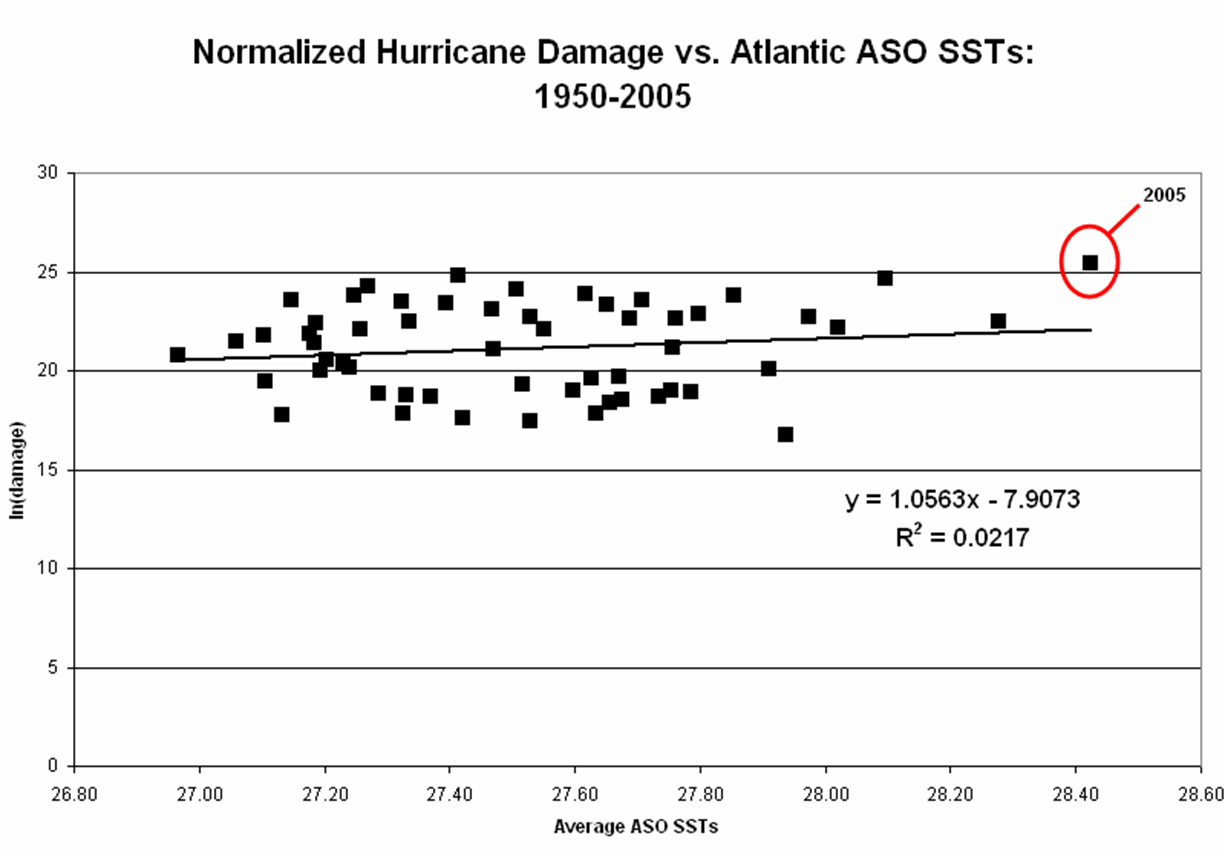
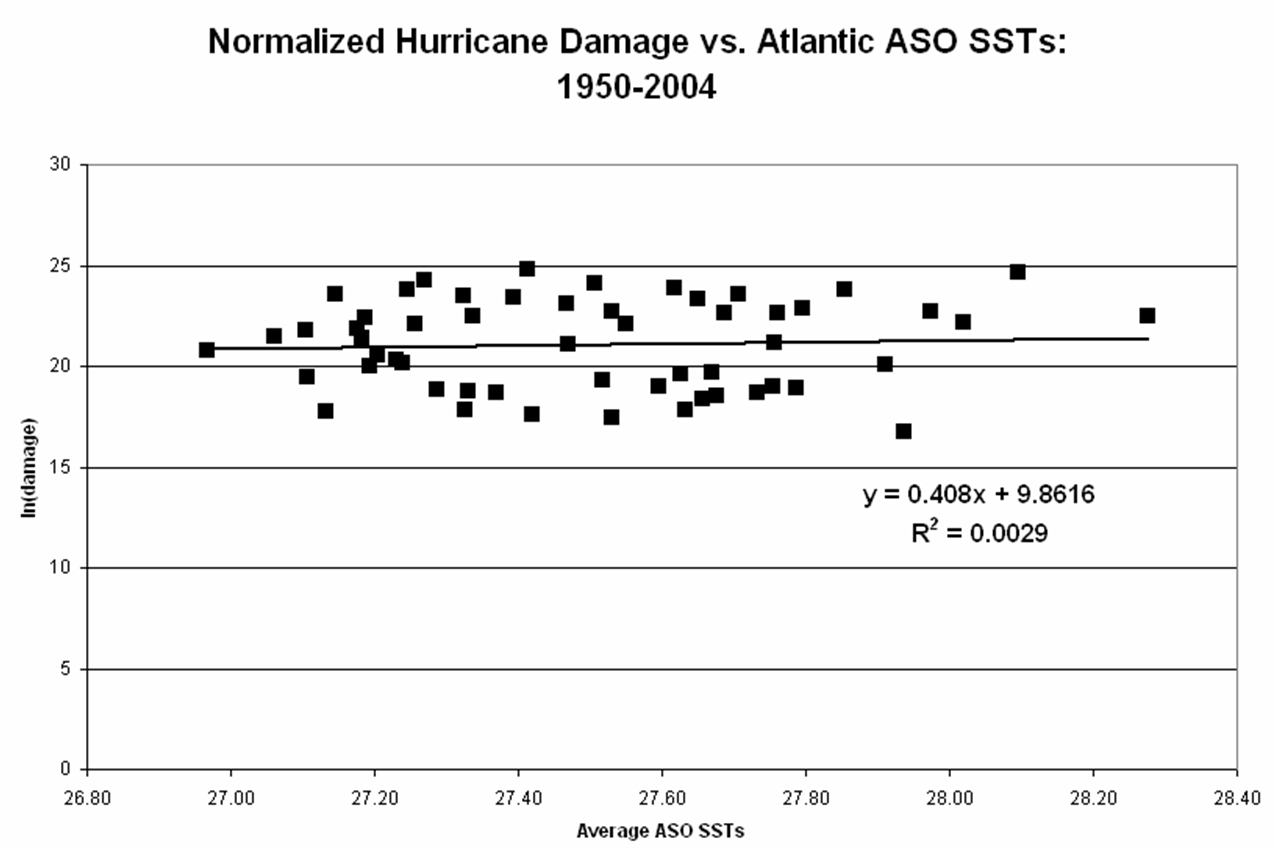
My argument is based on the following graphs.
In the paper I argue:
Figures 5.2.7a and 5.2.7b shows the lack of meaningful relationship between normalized U.S. hurricane damages (NHC data, transformed with the natural log) and North Atlantic [August, September, October = ASO] sea surface temperatures 1950-2005 and 1950-2004. The r-squared values are low with or without 2005 included, and the regression results are not statistically significant (p = 0.28 and 0.69 respectively). There is consequently no systematic evidence that higher SSTs are systematically associated with larger losses.
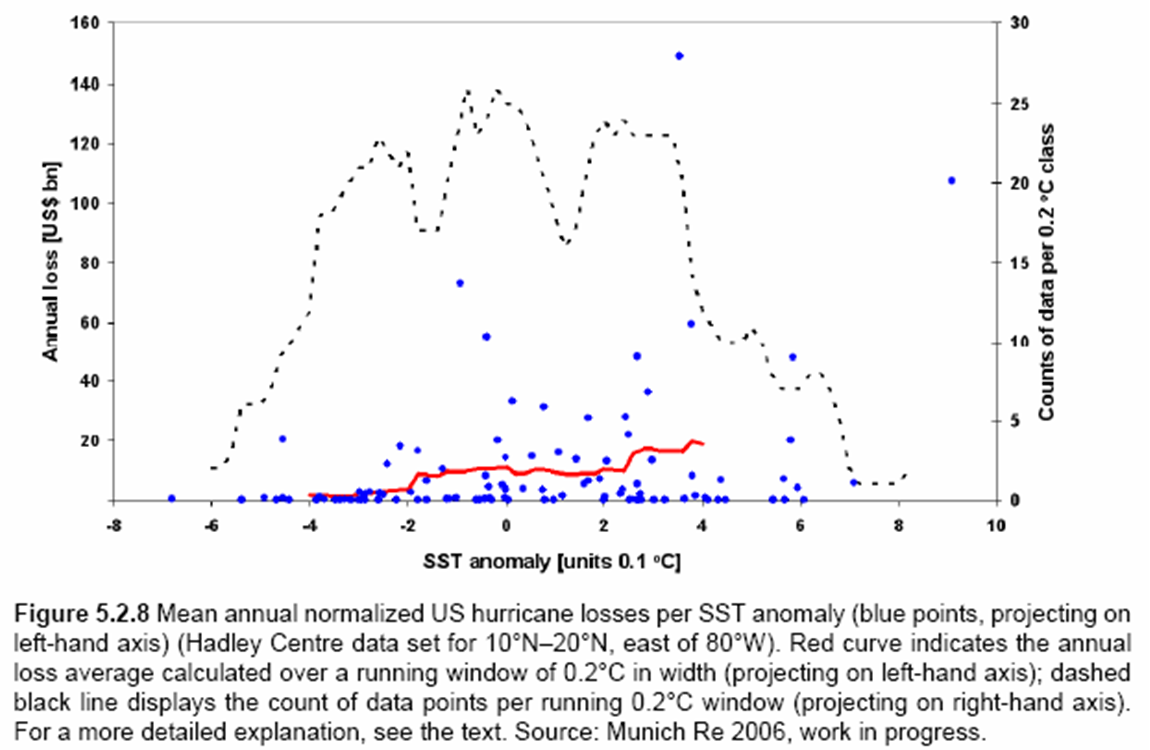
Eberhard’s begins with the following graph:
In the paper he argues:
But if analyzed more closely, the normalized loss data show nonetheless systematic changes over time. Fundamental to these changes is the presence of a correlation between normalized annual losses and June-October annual tropical sea surface temperatures. Munich Re analyzed the respective annual SST anomalies and annual normalized losses since 1900. Figure 5.2.8 simply displays the normalized losses against the SST anomalies. Also, the average loss calculated for a running window of 0.2°C in width is displayed (red line). The running average is shown over a range where the 0.2°C windows are populated densely enough (at least 12 data points, i.e. half the maximum population, see the dashed black line). A remarkable general increase in average annual normalized losses with increasing SST can be observed over the -0.4°C to +0.4°C anomaly range. Spearman’s rank correlation coefficient, which is independent of the distributions involved, gives 0.26 for the range from -0.4°C to +0.4°C and 0.28 for all of the data.
We both think that our respective analyses will be compelling. If you are interested, please read both analyses in full. Eberhard was a key participant in our workshop held last spring on Climate Change and Disaster Losses, the report of which you can find here. I’d be happy to discuss the two analyses in the WMO report in the comments if there is interest. Do note that neither of our perspectives have yet appeared in the peer-reviewed literature, but stay tuned.
For those of you interested in the other background reports prepared for the WMO workshop, they can be found here. In particular have a look at the Topic 4 “Climate variability and seasonal prediction of tropical cyclone activity/intensity” which includes a comprehensive literature review led by Tom Knutson (Special Topic 4a is also relevant). It is safe to conclude that debate persists on this subject. Topic 5 is relevant to those of you interested in policies related to tropical cyclones. We say it often enough here, but bears repeating — the debate over human-caused climate change and tropical cyclones is scientifically interesting and has become caught up in the politics of global warming, but there is no evidence that energy policies can ever serve as an effective means of modulating future hurricane damage given that the overwhelming factors responsible for increasing damage have been and will continue to be the ever-increasing vulnerability of people and property.