August 3, 2006
Climate Porn
The BBC has an article today about a new report from the U.K. based Institute for Public Policy Research (IPPR), which the BBC characterizes as a “Labour-leaning” think tank.
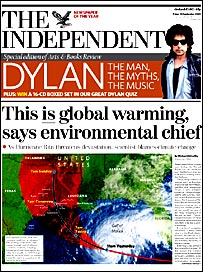
The alarmist language used to discuss climate change is tantamount to “climate porn”, offering a thrilling spectacle but ultimately distancing the public from the problem . . .
Simon Retallick, IPPR’s head of climate change, has this to say:
If the public is to be persuaded of the need to act we must understand how climate change is being communicated in the UK. Currently, climate communications too often terrify or thrill the reader or viewer while failing to make them feel that they can make a difference, which engenders inaction.
Government and green groups should avoid giving the impression that ‘we are all doomed’ and spend less time convincing people that climate change is real. . .
I very much agree with these views, but I do have two quibbles with the overview of the report. First, missing here is a discussion of the role of the climate science community, within which many have taken on as a personal mission the task of convincing people not only that climate change is real, but that anyone who deviates from the “consensus” should be vilified or silenced. Yes, there is a scientific consensus on climate change as described by the IPCC, but it offers little prospect of compelling a political consensus. Consequently, efforts to use science to force political action are in my view one of the driving factors behind “climate porn.”
Second, Retallick suggests a focus on “large actions” like hybrid cars or insulation instead of “small actions” like turning down the thermostat. From where I sit hybrid cars and wall insulation are “small actions” when compared to the challenge of stabilizing atmospheric greenhouse gas concentrations. The report does not go far enough in discussing the complete transformation of the global energy infrastructure needed to stabilize greenhouse gas concentrations at anything close to today’s levels. Where is the discussion of nuclear energy, vast investments in energy R&D, or even air capture? The report does not apparently acknowledge that solutions will unlikely to be motivated by climate concerns alone (as I discussed in my recent testimony before the U.S. Congress, PDF), which further underscores the pathological role played by climate porn.
Here is a longer excerpt from the IPPR website which describes the report:
The research analysed more than 600 articles from the UK press, as well as over 90 TV, radio and press ads, news clips and websites to find out how the media, government and green groups are communicating climate change.
The report argues that the discussion on climate change in the UK is confusing, contradictory and chaotic, and with the likely result that the public feels disempowered and uncompelled to act.
The report says that climate change communications should avoid using inflated or extreme language and placing the focus on small actions to solve the problem.
The report identifies ten different ways of talking about climate change, of which the first two are dominant:
*Alarmism (“we’re all going to die”): this pessimistic approach refers to climate change as awesome, terrible, immense and beyond human control. It excludes the possibility of real action – “The problem is just too big for us to take on”. Alarmism might even become secretly thrilling – effectively a form of “climate porn”. It is seen in almost every form of discussion on the issue.
“A world of climate chaos spiralling out of control”
* Small actions (“I’m doing my bit for the planet – and maybe my pocket”): the “small actions” approach is the dominant one in campaign communications from government and green groups. It asks a large number of people to do a few small things to counter climate change. The language is one of ease and domesticity with references to kettles and cars, ovens and light switches. It is often placed alongside alarmism. It is likely to beg the question: how can this really make a difference?
“20 things you can do to save the planet from destruction”