April 28, 2006
Al Gore’s Bad Start and What Just Ain’t So
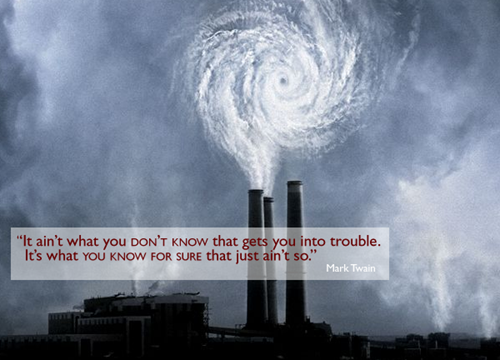
The image above is taken from the homepage of Al Gore’s new movie. If the imagery is indicative of the role of science in its presentations of policy options, then the case for action on climate change is going to suffer a setback. Reducing smokestack emissions, or any CO2 emissions, is simply not an effective tool of hurricane disaster mitigation.
Often on these pages we have made the case that the debate that rages over hurricanes and climate change is largely irrelevant to climate policy, even as it used as a symbol in climate politics. The reason for the insensitivity of policy to this debate is the overwhelming influence of societal factors in driving trends in the growth in disaster losses even under assumptions that global warming has significant effects on hurricanes. We have made the case in a wide range of fora and in a wide range of ways, and yet, it seems that the urge to use hurricanes as a justification for climate-related energy policies is just too appealing, despite its grossly unsupportable scientific grounding. It does not matter whether or not scientists can establish a link between global warming and hurricanes – it won’t affect how we think about climate policy.
More evidence for this perspective is provided in a recent news story about the insurance and reinsurance industries,
“Regardless of whether climate change is leading to increases in the number of storms or their intensity, analyses by ISO’s catastrophe modeling subsidiary, AIR Worldwide, indicate that catastrophe losses should be expected to double roughly every 10 years because of increases in construction costs, increases in the number of structures and changes in their characteristics,” said [Michael R.] Murray [ISO assistant vice president for financial analysis], “AIR’s research shows that, because of exposure growth, the one in one-hundred-year industry loss grew from $60 billion in 1995 to $110 billion in 2005, and it will likely grow to over $200 billion during the next 10 years.”
Assume a doubling of losses every ten years for the next 80, and you get a multiple of 2^8 or 256. Can anyone cite a study that suggests that hurricane frequencies or intensities will increase by 1/100 of this amount? (Note that damage is not linear with intensity, but even so.) You can’t. Even with less aggressive assumptions about societal change one still gets very, very large increases in impacts. For the simple math of why it is that societal growth dominates any scenario of the projected effects of climate change, and hence climate mitigation, on hurricanes, see this post we did a short while back. And there are umpteen others available on this site. I await the acceptance of this argument by the mainstream climate science community (as well as the relevant parties of the blogosphere), of which a troubling number have ignored or openly resisted this argument, and some very publicly yet without substance. But they shouldn’t, as it is about as solid a policy case as one can imagine.
As we have often said, climate mitigation makes sense, and so too does preparing for future disasters, but linking the first with the second is simply unsupported by an honest policy assessment. And it seems to me that honest assessments of policy action help the case for action on climate change. Al Gore is off to a bad start — let’s hope the rest of his effort is substantially better or else he risks setting back the case for action on climate change.