April 19, 2006
Long Live the Linear Model
Scholars who study the role of science in society have long dismissed the so-called “linear model” of science as descriptively inaccurate and normatively undesirable. In fact, within this community, such discussions are often viewed as pretty old stuff. However, when it comes to practicing scientists and many policy makers, the knowledge of the science studies crowd seems pretty far removed.
The linear model holds that investments in basic research are necessary and sufficient to stimulate scientific advancements, motivate technology developments, and bring products and serves to the market, where society benefits. The linear model was championed in Vannevar Bush’s post-war science policy manifesto titled “Science: the Endless Frontier” and has been fundamental to modern science policy ever since. Here is a graphic I made up illustrating the linear model.
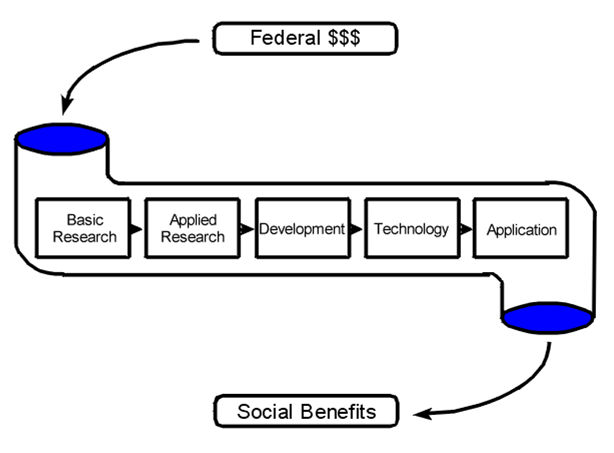
I am reminded almost daily at the depths to which the linear model shapes science policy, science advocacy, and science politics. Yesterday I came across an op-ed which used the linear model to argue for increased funding, at an exponential rate it seems, for health research, based on the linear model. Here is an excerpt:
In 2002, roughly one-third of the papers were from US research groups. By 2004, US groups accounted for only one-quarter of the publications. Government policy may be among the factors contributing to the gap between US and international publications in the field.
Why worry about this trend? The answer lies with our biomedical ”discovery machine,” which operates on a seven-step assembly line:
1.) An academic scientist designs an experiment to answer an important question.
2.) The scientist applies to the government to fund the research.
3.) The money pays for students and fellows who conduct the research.
4.) The results are published in journals, which advance the field.
5.) An invention may result. This may lead to a patent, which then is licensed to a start-up company.
6.) With a monopoly granted by the patent, the company attracts venture capital. If it is successful, the company grows.
7.) Years later, the discovery becomes a therapy for patients.
It takes $28.8 billion, the annual budget of the NIH, to prime this machine. Every year, the money generates an astonishing amount of fundamental knowledge and thousands of biomedical discoveries. With no initial funding, this apparatus stops at Step 1.
With no money, what do the scientists do? They choose other careers. Worse, they leave to do research in other countries.
When scientists abandon their laboratories, a field can vanish. A scientific discipline is designed to grow exponentially. A professor will train a handful of students, some of whom go on to become professors and train more students. Some PhDs enter industry, where they lead projects and hire more trained workers. Funded properly, this collection of specialists becomes a formidable force, building research centers, driving innovation, and creating business sectors. The government front-loads the process; ingenuity and free enterprise takes care of the rest.
Scientists often get quite worked up when scientific knowledge is mispresented in the media, and rightly so. However, it seems that the bar is set quite a bit lower when it comes to the (mis)representation of knowledge from science studies.