November 9, 2005
Avoiding the Painfully Obvious
Over at RealClimate Gavin Schmidt has written a post defending the IPCC against a critique by Nigel Lawson, a member of the British House of Lords and former chancellor of the exchequer. An exchange I had with Gavin in the comments aptly illustrates why some people agree with Lawson when he claims, “the IPCC’s apparent determination to suppress or ignore dissenting views, which has become little short of a scandal, is part of a wider problem.”
Lawson has some strong things to say, “The IPCC process is so flawed, and the institution so closed to reason, that it would be far better to thank it for the work it has done, close it down, and transfer all future international collaboration on the issue of climate change to the established Bretton Woods institutions.” For his part Schmidt, gives no ground in his defense, “The IPCC makes its assessments in a very thorough writing and review process involving hundreds of scientists, open to critics, with transparent and predefined procedures. That it makes no proclamations in between the full assessments is not a ’scandal’, it simply is sticking to its sound and transparent procedures.” An open discussion on the IPCC is worth having. But here I’d like to focus in on how an exchange I had with Gavin reinforces one of Lawson’s main complaints about the IPCC and the climate science community, an inability to admit error.
Lawson points to those making connections of global warming and hurricanes Katrina and Rita as an indication of scientific excess. Schmidt responds as follows:
“Just how much of an error is revealed by Lawson’s last paragraphs in which he, ironically, he uses the notion of a scientific consensus to combat (admittedly widespread) popular claims of a direct link between the individual impacts of Hurricanes Katrina and Rita and global warming. Since no scientists have made a claim of direct cause and effect (see our recent post on potential statistical links between hurricane intensity and tropical warming), any scientific assessment (such as the next IPCC report) will certainly not do so either. It is precisely because such anecdotal ’science’ is not a balanced picture of the state-of-the-art that IPCC exists in the first place.”
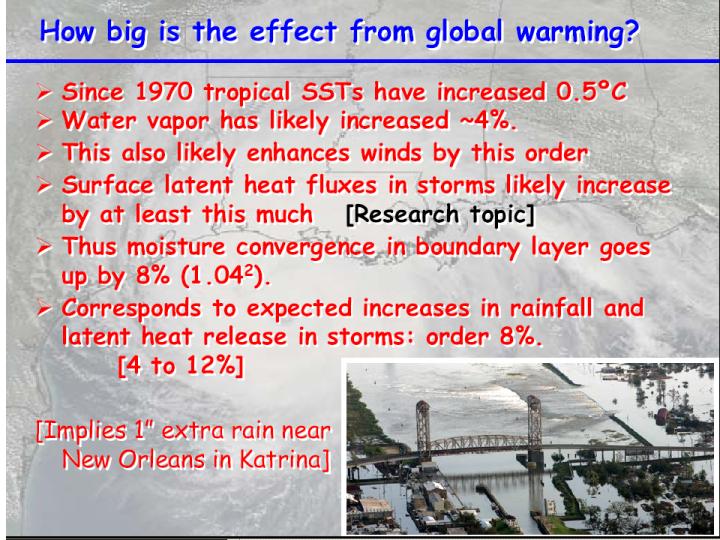
I agree with Schmidt’s general comments. But I pointed out to Schmidt that he was simply wrong is his assertion that no scientist has made a claim of direct cause and effect. In fact, Kevin Trenberth who, ironically enough, is the lead author of the IPCC chapter on hurricanes, made an explicit connection between global warming and hurricane Katrina just last week in a congressional briefing organized by the American Meteorological Society. In one of Trenberth’s slides (PDF), reproduced below, he asks, “how big is the effect from global warming?” and answers, “Implies 1″ extra rain near New Orleans” right next to a picture of flooding and damage.
Let’s state the obvious. Trenberth is making a clear attribution between global warming and hurricane Katrina, and is suggesting a connection to the flooding. This is troubling because, as I pointed out on RealClimate, “Perhaps there are good scientific reasons for making such a claim, but they probably should go through peer review before being announced as fact (with no sense of uncertainty!) before policy makers. Especially when other scientists, like Kerry Emannuel, assert that such precise attribution is not possible. And further, given that the IADWG has published in JOC May 2005 that attribution of trends in precipitation to GHGs has not yet occurred, it stretches the credulity of this non-climate scientist to think that such precise attribution is possible for specific events.” Yet when I pointed this out to Schmidt, instead of admitting the obvious, he says the following:
“… you appear to be putting words into Trenberth’s mouth. He does not claim that Katrina was caused by global warming, and I’m surprised that you continue to interpret his words now and last year to conclude this. He has claimed that global warming is changing the background in which hurricanes form (which is clearly true), but that can in no way be construed as arguing that Katrina can be directly attributed to global warming. Trenberth is as aware as we are that individual events are not attributable in the sense that Lawson implies, and any consensus statement on the issue will agree. Let’s not be distracted by semantics.”
I find this response amazing because Schmidt is telling me not to believe my own eyes. When pressed Schmidt himself falls back on semantics, “I read the slide, and frankly, even if the context in which Trenberth placed the comment is as you assume, it is still not a direct attribution of a specific hurricane to global warming. To keep belabouring this point, it is quite clearly not what Lawson is referring to.” Can Schmidt think that such parsing will be taken seriously? How about simply stating that Trenberth is a bit forward on his skis here? Why the denial?
This is exactly the sort of behavior that Lawson has concerns about (and incidently which was cited as a factor in Chris Landsea’s resignation from the IPCC.). It is no wonder that some people are losing faith in the IPCC, its leaders and defenders seem to be incapable of admitting the validity of any dissenting views, even when those dissenting views are obviously correct right before your eyes.